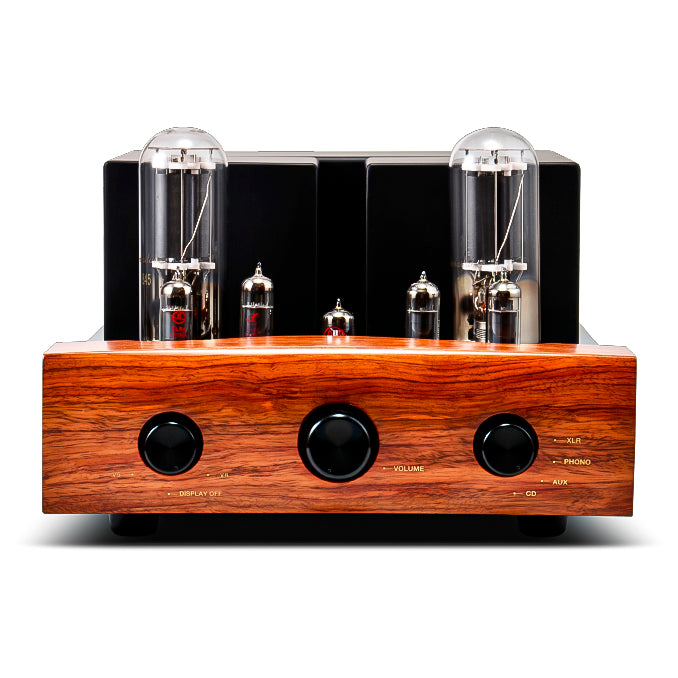

Since October, we have started handling the Chinese audio brand Jasmine Audio.
Jasmine Audio is a noteworthy pure audio brand established in China in 2001 by enthusiastic audio lovers, and it has also received awards abroad. Its components, carefully crafted with attention to detail, are meticulously assembled by experienced and qualified engineers. This is the official brand introduction (abridged), but the actual products we procured are extremely well made.Bakoon ProductsWith the great cooperation of the representative Mr. Nagai, I would like to introduce them.
Jasmine Audio develops products for record listening, from cartridges to turntables to phono equalizers, and their turntables are only belt-driven. The photo shows the T-D200MK2. It supports double arms, and its build quality is very solid (as expected).
Bakoon ProductsThe Jasmine products we have are as follows:
TT-D200MK2 Belt-drive turntable (currently switching to a new model)
JS-TAAB Air-bearing tonearm
JS-TB297 12-inch dynamic balance tonearm
MC Cartridge B&W Ceramic Series "TIGER"
MC Cartridge Nature Series Forest
MM Cartridge Series - M1
About the belt-drive turntable TT-D200MK2

We have received a setup report for the belt-drive turntable TT-D200MK2.
The 8-kilogram platter is floated with a strong magnet for very smooth operation.

However,
It was reported that the platter wobbled (sweat), and the cause seemed to be that the magnet was too strong and it didn't sink completely; it was temporarily fixed with a stabilizer of about 1 kilogram.
After that, following Jasmine's instructions, the bearing hole was cleaned with oil and oil was applied, which resolved the issue. Just be careful not to add too much oil, as it may overflow and seep out for a while.
This turntable was the last item in the manufacturer's stock, and for some reason it was not packed in a dedicated case. It was just crammed into a ready-made package for shipment, which I think had a considerable impact. When I actually inquired with the manufacturer, it seems that this was a symptom that had never occurred before. So, I believe that if it is packed in a dedicated package in the future, this problem will not happen.
As for the actual product, the finish is very beautiful. The turntable supports double arms, but for the second arm, an optional protruding base is essential, and having a separate base for the tonearm would make the setup considerably easier. (Mr. Nagai’s effort will come later.)

Now, regarding the operation after the problem was resolved,Bakoon Productsit seems that its performance exceeded Mr. Nagai’s expectations (pleasantly surprising), and he highly praised it, saying that such performance at this price cannot be obtained in Japan!!
We secured a promise that Jasmine Audio would directly correct the points and fixes that Mr. Nagai pointed out. Jasmine responds very quickly to issues, which shows their high level of commitment.
Mr. Nagai has kindly provided his impressions of the TT-D200MK2 over the past two months again, as outlined below.
I think its performance as a turntable is great. The platter is floated by about 8mm due to the magnet installed around the axis. I think it's the same principle as the Magnefloat that TEAC commercialized in the past, and I think it greatly contributes to smooth rotation and vibration prevention. However, the unit I used had a problem with resonance between the magnetic float and belt drive, causing vertical vibration during playback, but after injecting oil into the bearing, the vibration disappeared. Since the platter is suspended by a magnet, if a heavy stabilizer is placed on it, the platter will sink and the height of the arm will change. In addition, the record is supported by six points on the platter, and these supports are slightly lifted from the platter, so if you put a stabilizer on it, the record will warp. It is best not to use a stabilizer with this product, or to use a lighter one. Two arms can be attached: a conventional arm and the company's linear tracking arm. A special base is included for installing a conventional tone arm, and any pipe-based arm with the same diameter as the company's arm can be installed as is. If not, you will need to make your own mounting base. The base of the turntable appears to be a laminated aluminum material. It has enough weight and looks cool. The base is supported by three rubber feet with bolts that are screwed into the bottom to adjust the height. The rubber feet are hard like regular rubber, so there is no vibration absorption here. When you walk on the floor, the needles may fly or noise may occur. However, since the platter is held afloat by a magnet, there does not seem to be any feedback. The motor has two speeds, 33 1/3 and 45 rpm, but the variable range is wide and I was able to increase the rotation speed from 33 rpm to 78 rpm. A stroboscope is required to adjust the speed, and now that lighting has changed from fluorescent lights to LEDs, a special fluorescent light stand that flashes at a commercial frequency is required. Unfortunately, the power cable for the motor comes out from the front, making cable management a pain, so I wish it had come out at the back. The sound was of high-end quality, and even the enthusiasts who came to listen to it at our company were very surprised. It has very high quality for a turntable that can be purchased at this price. It is not recommended for beginners as it requires a certain amount of knowledge to properly install the arm and adjust the rotation speed.
This Jasmine belt drive turntable is currently undergoing a model change (image below), incorporating the opinions of our store and Mr. Nagai of Bakoon. Act fast! ! However, I don't think it will have a flash. .
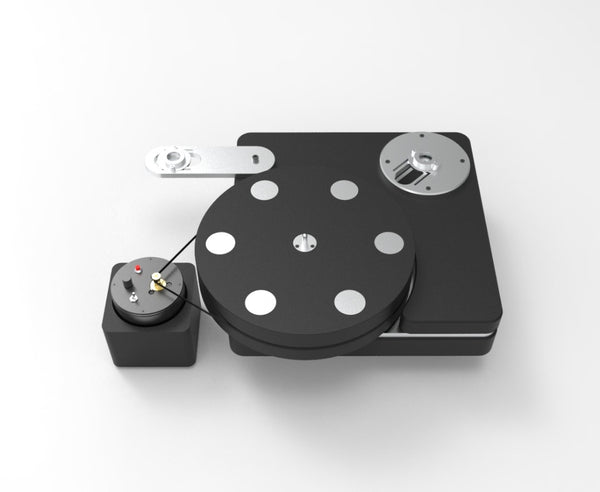

To TT-D200MK2linear tracking arm
When installing JS-TAAB, use the normalThere was only enough space to attach the two bases to the base of the tone arm, so it seems that Mr. Nagai had a lot of trouble.

After the installation was finally completed, Mr. Nagai describes the difficulties he had in setting it up below. . 『I used a spirit level to level the base as precisely as possible. Fix the position of the arm so that the tip of the cartridge stylus is centered on the shaft of the turntable, and apply 2 g of stylus pressure using the stylus pressure gauge. It came with two weights, so I balanced it in the center to make it easier to balance it, but it didn't work properly. I thought there wasn't enough air pressure, so I turned it up to maximum, but it still flew off. When I looked at the instruction manual, I noticed that only one balance weight was used. When using only one weight, the DL-103 can barely achieve zero balance. Then I played it and it worked fine. It seems like they had a lot of trouble, but the conclusion is that the adjustment range is limited when the mount position is a linear tracking arm, and it seems that this phenomenon occurred because the settings were not perfect. Cartridges can be installed in a wide range of 6 to 18g, and with the DL-103, one weight should be enough.

In fact, the installation photo from the manufacturer shows it set on a protruding pedestal, and I have already requested that Jasmine include a special adjustable protruding pedestal. And they have already sent us the CAD images of the new pedestal renderings! Work done!
My impressions of the important linear tracking arm,
``The pump is almost silent even when placed nearby. The sound played isAbsolutely unwavering sound that you've never heard before. Although it is not an easy-to-use arm,Recommended for those seeking the best sound.』
Bakoon ProductsI never expected to receive such words from the representative of ! !
I think the price is much cheaper than the linear tracking arms on the market. If you are interested in this arm that Mr. Nagai highly praised, we look forward to hearing from you! !
I once again asked Mr. Nagai to review the product, and he kindly wrote a lengthy review. After all, it seems that both first and second adjustments are ``life''. The secret of analog audio is that heaven is waiting for you beyond precise settings. .
— The JS-TABB is a highly ambitious creation by Jasmine Co., a linear tracking arm that uses air bearings. The arm itself and the air pump come as a set, and the pump sends high-pressure air to the air bearings, allowing the arm attached to the air bearings to float in the air, eliminating friction and achieving linear tracking. Using this tonearm allows you to obtain clearer and higher-resolution sound, but its adjustment is more critical. If not adjusted precisely, the arm may not even operate. First, attach the cartridge to the arm to determine the arm’s position. Adjust it so that the cartridge's stylus aligns with the center of the turntable spindle. It can also be adjusted using the included jig. Connect the arm and pump with the supplied pipe. Turn on the pump and position it far enough away that the pump noise cannot be heard. The pump noise is quiet, but if you listen carefully in a silent environment, it can be faintly heard, so placing it several meters away makes it inaudible. Set the arm to the base position and check the horizontal alignment of the air bearing’s shaft. The horizontal alignment of this shaft is the most important factor for the proper operation of this arm, so adjust it precisely using a sensitive level. It is fine if the turntable base is level, but even a slight misalignment can prevent operation, so the shaft’s horizontal alignment must be matched precisely. The arm will not function properly if moved by hand. The gap between the air bearing and the shaft is only 5 microns, so if moved by hand or if excessive force is applied, they will come into contact. Therefore, when moving the arm by hand, extreme care must be taken to avoid applying excessive force. Next, apply tracking force to the installed cartridge. A stylus force gauge is necessary to apply the tracking force because the weight does not have tracking force markings. Then, lower the cartridge onto a stationary record and adjust the arm’s height so that the cartridge is level using a commercially available jig. At this time, adjust the arm, air pipe connected to the main body, and signal cable into a gentle arch as shown in the instruction manual’s photo. The cables and pipes can interfere with the movement of the air bearing. Therefore, the distance of the arm from the turntable center and the shape of the cable bends significantly affect operation. These fine adjustments areYou adjust it so that when you try playing a record, one side plays smoothly. Therefore, patience is required to make it work without issues. However, the sound quality you get from this arm is incredible. It makes you forget the time-consuming effort of adjustment.
About the JS-TB297 12-inch Dynamic Balance Tonearm
It is a high-end, S-shaped long arm in Jasmine's tonearm series. Even though it's high-end, compared to domestic and Western models, it is mid-range in price. Without the influence of the weak yen, it would be more affordable.
This JS-TB297 is now becoming close to the Bakoon reference, so we asked Mr. Nagai to give us his impressions.

-This arm has a unique shape with the center offset to the right from the axis. The tracking force is not applied by weight but uses another mechanism such as a spring in a dynamic balance system. As stated in the catalog, it is said to absorb and inherit the essence of the best tonearm designs so far. Therefore, there are many similarities to famous tonearms. However, it is realized at a higher level by Jasmine's technology using the latest precision processing technology and new materials. When auditioned in combination with the company's turntables, the first impression is that it sounds high-end. Its clear and information-rich sound was evaluated by listeners as resembling digital high-resolution audio. To bring out this capability, proper setup and adjustment are necessary, and jigs to check the vertical and horizontal alignment of the cartridge and test records to adjust anti-skating are indispensable.
To do this, the turntable must be strictly horizontal. Use the turntable's height adjustment mechanism to properly adjust X and Y using a spirit level. A special plastic jig is included to adjust the overhang that determines the arm position, so use that. Secure the arm base to the turntable mounting base with two screws. However, although this screw has a knurl, it cannot be used with a screwdriver or wrench, so you have to pinch it with your fingers and turn it to secure it. The surface has a matte finish and is slippery, so make sure to fix it firmly. It's a normal tonearm that applies pressure by turning it counterclockwise, so I was confused at first by the JS-TB297, which applies pressure by turning it clockwise. The weight of usable cartridges is 5 to 17g, but if you install a light cartridge like the company's M2, the balance weight will be very close to the center. In this case, it becomes difficult to turn the stylus pressure pressure knob, and it is necessary to add weight to the cartridge. Next, align the cartridge horizontally and vertically. Lower the cartridge with appropriate stylus pressure onto a stationary record, use a commercially available jig to level the cartridge, adjust the height of the arm, and use the jig to align it. Vertically, adjust the vertical inclination of the shell by loosening the screw that holds the shell connector on the arm, but I think it will be easier to match it if you use a cartridge with a vertical line on it, such as DL-103. Lateral balance is a static balance, so it would be best to match it to the scale, but inside force canceller is non-linear, so use the third track on the B side of the Audio Association's test record or a special acrylic test record. Apply the stylus pressure you are using and lower the stylus to the center of the track, about 9cm to 12.5cm from the center and adjust so that the cartridge does not flow left or right. Strictly speaking, this method is anti-skating rather than inside force cancellation, but the adjustment will result in less distortion. There is a scale on the weight axis of the Inside Force Canceller, but this is completely unreliable. Adjustment using the above test record is necessary as it varies greatly depending on the cartridge. After making these adjustments and listening, you will hear very clear, high-resolution, high-end sound.
To do this, the turntable must be strictly horizontal. Use the turntable's height adjustment mechanism to properly adjust X and Y using a spirit level. A special plastic jig is included to adjust the overhang that determines the arm position, so use that. Secure the arm base to the turntable mounting base with two screws. However, although this screw has a knurl, it cannot be used with a screwdriver or wrench, so you have to pinch it with your fingers and turn it to secure it. The surface has a matte finish and is slippery, so make sure to fix it firmly. It's a normal tonearm that applies pressure by turning it counterclockwise, so I was confused at first by the JS-TB297, which applies pressure by turning it clockwise. The weight of usable cartridges is 5 to 17g, but if you install a light cartridge like the company's M2, the balance weight will be very close to the center. In this case, it becomes difficult to turn the stylus pressure pressure knob, and it is necessary to add weight to the cartridge. Next, align the cartridge horizontally and vertically. Lower the cartridge with appropriate stylus pressure onto a stationary record, use a commercially available jig to level the cartridge, adjust the height of the arm, and use the jig to align it. Vertically, adjust the vertical inclination of the shell by loosening the screw that holds the shell connector on the arm, but I think it will be easier to match it if you use a cartridge with a vertical line on it, such as DL-103. Lateral balance is a static balance, so it would be best to match it to the scale, but inside force canceller is non-linear, so use the third track on the B side of the Audio Association's test record or a special acrylic test record. Apply the stylus pressure you are using and lower the stylus to the center of the track, about 9cm to 12.5cm from the center and adjust so that the cartridge does not flow left or right. Strictly speaking, this method is anti-skating rather than inside force cancellation, but the adjustment will result in less distortion. There is a scale on the weight axis of the Inside Force Canceller, but this is completely unreliable. Adjustment using the above test record is necessary as it varies greatly depending on the cartridge. After making these adjustments and listening, you will hear very clear, high-resolution, high-end sound.