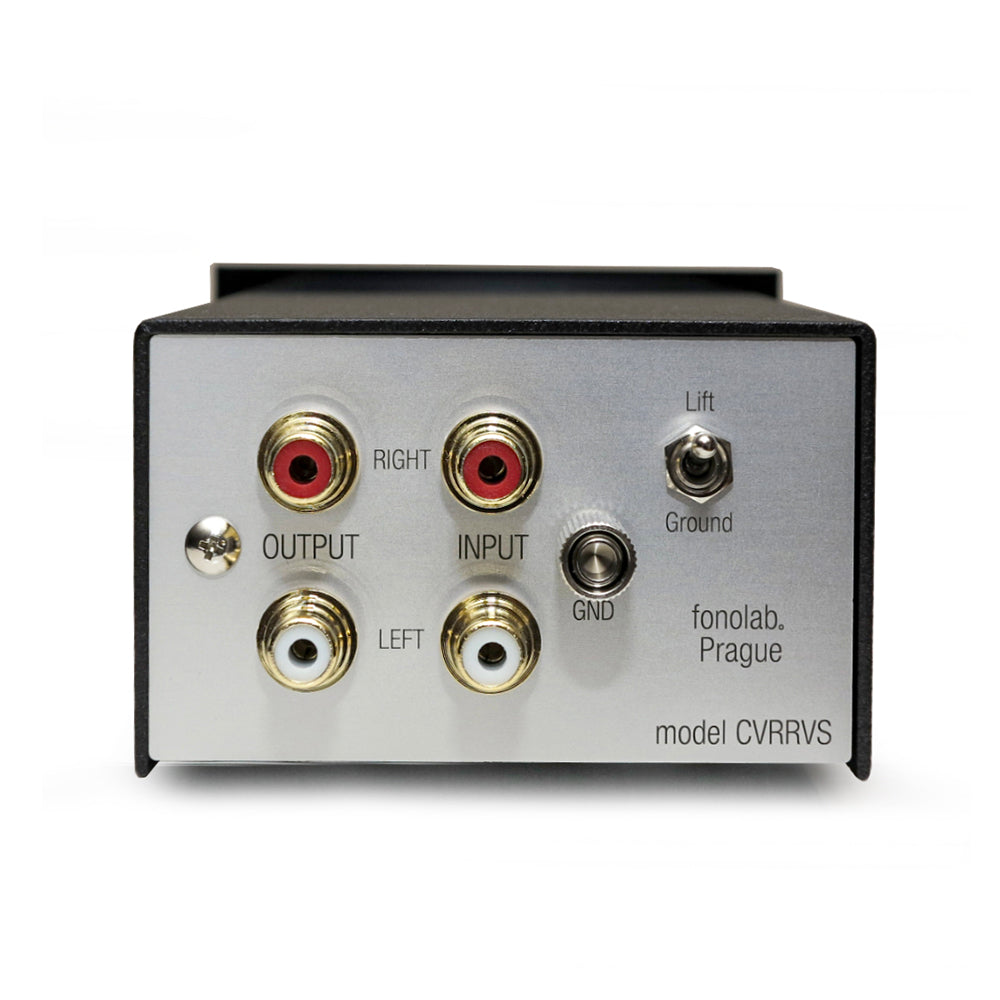


Fonolab CVRRVS MM/MI Phase Equalizer
Product code:Fonolab CVRRVS MM/MI Phase Equalizer
Could not load the receipt status
From your usual MM cartridge, you can experience a delicacy you've never heard before.
Passive control that adjusts phase delay and resonance only to suit your single piece
Why does the sound change with the same cartridge?
The sound of MM/MI cartridges is actually not determined by the cartridge alone. The interaction between the inductance of the power generation coil and the input conditions of the phono equalizer greatly influences the final sound. Inductance delays the phase of the signal (inductive lag) as it moves toward higher frequencies, simultaneously generating electrical resonance with the load. This is why the high frequencies become wild, subtle muddy, and the original delicate expressions become blurred. CVRRVS is a passive control stage designed to balance this "phase delay" and "resonance." No amplification is performed at all, and no active elements are inserted into the signal path; only the "connection" between the cartridge and the phonoico is optimized.
■ Switch between two modes: DIRECT and EQ
On this device, you can select "DIRECT" and "EQ" using the selector on the left. DIRECT is a straightforward route that sends the cartridge's signal directly to the phonoico without any correction. EQ is a mode that applies corrections refined by PHASE EQ via a phase correction network. With one-touch switching, you can instantly compare A/B with or without correction, and confirm the best fit for your cartridge and system by ear.
■ PHASE EQ: Tailored to your cartridge
The PHASE EQ dial on the right is used to adjust the correction amount. The phase delay caused by cartridge inductance varies in value for each cartridge. That's why CVRRVS doesn't set the correction in place; instead, it adjusts the passive RL (LR) network according to the frequency to ensure it fits your cartridge perfectly. Turning the dial to find the point where phase coherence (phase alignment) is restored and the frequency response is flat—this one step returns as a clear difference in the sound.
I can hear the 'invisible expression' the needle was picking up.
When properly arranged, the outlook for the treble changes first. The roughness and hardness that had lingered in the ears faded away, and the lingering resonance of cymbals and the breath of vocals naturally developed. By organizing resonance and phase imbalances, the thin veil covering the soundstage was lifted, revealing subtle nuances hidden deep inside—the sound of fingers scraping the frets, the hall'sholographic soundstage—But she quietly steps forward. It is not a device that flashily changes the tone. In fact, even though it doesn't feel like "something has been added," before you know it, the amount of information increases and the music sounds much clearer. That quiet persuasiveness is the true value of CVRRVS.
Especially in an analog environment like this,
Ideal for those concerned about high frequency disturbances or phase distortions, those who want to set the optimal score for each cartridge themselves, and those who want to improve quality by "adjusting" rather than "adding" gain. You can compare it with DIRECT, so those already satisfied with their system will be able to feel the difference in effectiveness. This is a device that takes the accuracy of the MM interface to the next level.
Main Features
- Passive configuration without amplification stages:Instead of stepping up the millimeter, do not insert active elements into the signal path, and keep it pure.
- Resonance is adjusted by the load that varies with frequency: Instead of a fixed resistor with a fixed load, the passive RL network changes the load according to frequency, braking electrical resonance without excess or deficiency.
- Phase alignment and flattening of characteristics: By correcting phase delay, the high-frequency disturbance is suppressed, and the frequency response is naturally regulated.
- The cartridge's unique character remains intact.: Rather than changing your background, you only optimize how you interact with Phonoiko.
| Type | MM/MI Interface Control (Phase EQ) |
|---|---|
| Composition | Passive RL (LR) network (no amplification or boost) |
| operations department | DIRECT/EQ selector, PHASE EQ adjustment dial |
| Input | MM/MI Cartridges |
| exert effort | Phono Stage Input (RCA) |
| load impedance | 50kΩ |
| frequency response | 5Hz–100kHz(±0.5dB) |
*This is a special order item. Shipping may take about 3~4 weeks.From your usual MM cartridge, you can experience a delicacy you've never heard before
.It does not amplify it. Passive control that adjusts phase delay and resonance only to suit your single piece
DescriptionWhy does the sound change with the same cartridge
?The sound of MM/MI cartridges is actually not determined by the cartridge alone. The interaction between the inductance of the power generation coil and the input conditions of the phono equalizer greatly influences the final sound. Inductance delays the phase of the signal (inductive lag) as it moves toward higher frequencies, simultaneously generating electrical resonance with the load. This is why the high frequencies become wild, subtle muddy, and the original delicate expressions become blurred. CVRRVS is a passive control stage designed to balance this "phase delay" and "resonance." No amplification is performed at all, and no active elements are inserted into the signal path; only the "connection" between the cartridge and the phonoico is optimized.
■ Switch between twomodes: DIRECT and EQ
On this device, you can select "DIRECT" and "EQ" using the selector on the left. DIRECT is a straightforward route that sends the cartridge's signal directly to the phonoico without any correction. EQ is a mode that applies corrections refined by PHASE EQ via a phase correction network. With one-touch switching, you can instantly compare A/B with or without correction, and confirm the best fit for your cartridge and system by ear.
■ PHASE EQ: Tailored to your cartridge
The PHASE EQ dial on the right is used to adjust the correction amount. The phase delay caused by cartridge inductance varies in value for each cartridge. That's why CVRRVS doesn't set the correction in place; instead, it adjusts the passive RL (LR) network according to the frequency to ensure it fits your cartridge perfectly. Turning the dial to find the point where phase coherence (phase alignment) is restored and the frequency response is flat—this one step returns as a clear difference in the sound.
I canhear the 'invisible expression' the needle was picking up
.When properly arranged, the outlook for the treble changes first. The roughness and hardness that had lingered in the ears faded away, and the lingering resonance of cymbals and the breath of vocals naturally developed. By organizing resonance and phase imbalances, the thin veil covering the soundstage was lifted, revealing subtle nuances hidden deep inside—the sound of fingers scraping the frets, the hall'sholographic soundstage—But she quietly steps forward. It is not a device that flashily changes the tone. In fact, even though it doesn't feel like "something has been added," before you know it, the amount of information increases and the music sounds much clearer. That quiet persuasiveness is the true value of CVRRVS.
Especially in an analog environment like this
,Ideal for those concerned about high frequency disturbances or phase distortions, those who want to set the optimal score for each cartridge themselves, and those who want to improve quality by "adjusting" rather than "adding" gain. You can compare it with DIRECT, so those already satisfied with their system will be able to feel the difference in effectiveness. This is a device that takes the accuracy of the MM interface to the next level.
Main Features
- Passive configuration without amplification stage: Instead of stepping up the MM, it maintains a pure signal path without inserting active elements into the signal.
- DIRECT / EQ Selector (Left Dial): Switch between DIRECT without correction and EQ with phase correction with one touch. You can compare A/B on the spot.
- PHASE EQ Adjustment Dial (Right Dial): You can fine-tune the correction for phase delay caused by the cartridge’s inductance to match your individual unit.
- Adjusting Resonance with Frequency-Dependent Load: Instead of a fixed resistive load, the passive RL network changes the load according to frequency, controlling electrical resonance precisely without excess or deficiency.
- Phase Alignment and Flattening of Characteristics: By correcting phase delays, high-frequency instabilities are settled, and the frequency response naturally becomes balanced.
- Maintaining the Cartridge’s Character: Rather than changing its inherent traits, it optimizes only the way it interacts with the phono preamp.
| Type | MM/MI Interface Control (Phase EQ) |
|---|---|
| Configuration | Passive RL (LR) Network (No Amplification or Step-Up) |
| Controls | DIRECT/EQ Selector, PHASE EQ Adjustment Dial |
| Input | MM/MI Cartridge |
| Output | Phono Stage Input (RCA) |
| Load Impedance | 50kΩ |
| Frequency Response | 5Hz–100kHz (±0.5dB) |