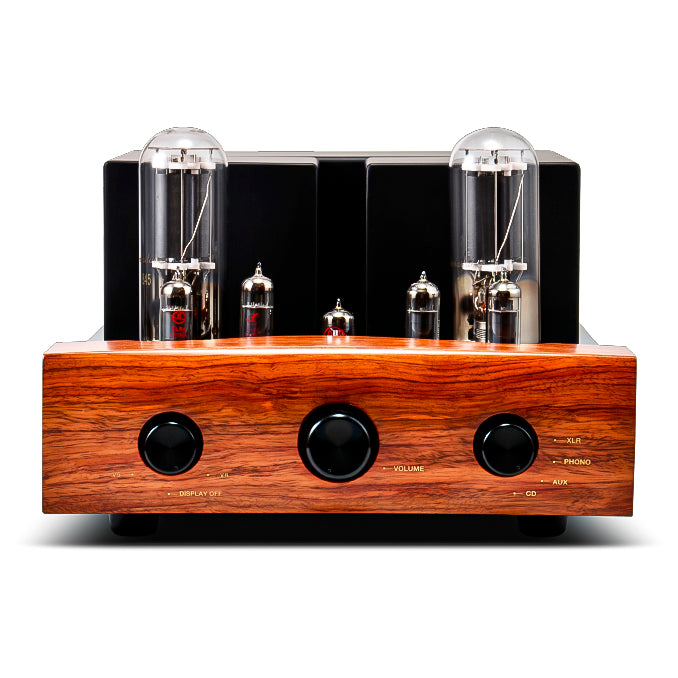

As the name suggests, OTL amplifier (Output Transformer Less amplifier)without using an output transformerThis is an amplifier designed to deliver signals from the vacuum tube output stage to the speakers. Typical vacuum tube power amplifiers use an output transformer to adapt the high output impedance of the vacuum tube to the speaker. On the other hand, OTL eliminates the "conversion device" and avoids the restrictions and coloring associated with transformers, and achieves speaker drive using a different method. This is where the charm and difficulty of OTL coexist.
1. What the output transformer contributes to the “sound” and the aim of OTL
The output transformer is the heart of a tube amplifier. It is responsible not only for impedance matching, but also for electrical insulation, direct current interruption, and establishing a gain structure. However, at the same time, since a transformer is a physical device, it deviates from the ideal. For example, it is difficult to avoid magnetization and saturation of the iron core in the low range, leakage inductance and parasitic capacitance of the winding in the high range, phase rotation at the edge of the band, and characteristics that change depending on load conditions. A better transformer will achieve a wider band, lower distortion, and lower loss, but it will also increase in size, weight, and cost, and will still be affected by speaker impedance fluctuations.
OTL cuts here. **The idea is that "not passing through a transformer = not subject to the limitations of a transformer"**. As a result, the clarity, especially in the mid-high range,fast transient responseIt is said that it is easy to find its unique charm in its reproduction of minute signal nuances and clarity of the sound image. Of course, it is appropriate to understand that OTL is a method that tries to approach the ideal with a different approach, rather than saying that the transformer is bad.
2. Circuit approach to establish OTL
The biggest hurdle isVacuum tube output impedance is highThat's it. Since there is no transformer, it will not be possible to powerfully brake speakers around 8 ohms as is. Therefore, OTL mainly uses the following methods.
(1) Lower impedance by paralleling many
Typically, multiple twin triode tubes with low internal resistance such as 6AS7/6080 are connected in parallel to lower the output impedance and increase current supply capability. As a result,The number of vacuum tubes tends to be largeThis will increase heat generation, but it is the standard way to easily obtain OTL-like driving force.
(2) Cathode Follower Output, SRPP, White Cathode Follower, etc.
As for the type of output stage, circuits that make it easier to aim for low output impedance are chosen. In any case, these are measures to make it easier to supply current, but the peculiarities of the circuit, stability, and compatibility with the tubes used directly affect the sound.
(3) Presence or absence of an output capacitor (Direct coupling or capacitor coupling)
OTL means "output transformerless," butwhether to put a capacitor in the outputis a separate issue. A method of inserting a large capacitor in series with the speaker to block DC is easy to implement, but the low-frequency texture changes depending on the quality and value of the capacitor. On the other hand, designs that insist ondirect couplingmake DC offset management and protection circuits more difficult, but reduce component intermediaries. In OTL design, the character varies depending on which approach is taken.
[Input] → [Voltage Amplification Stage] → [Driver Stage] → [OTL Output Stage] → [DC Measures/Protection] → [Speaker]
+B
|
+-----+-----+
| |
Upper Output Group Lower Output Group
(Current Supply / Pull-Up) (Current Draw / Pull-Down)
| |
+-----+-----+----o Output Node
|
+---||---o----[SP]----o GND
Cout
In OTL, a design that does not let DC flow to the speaker is essential. A typical example is the method of inserting a large capacitor (Cout) in series with the output to block DC. The capacitor's capacity and quality also affect the low-frequency texture.
3. How to Perceive OTL Sound Characteristics
When talking about OTL, common impressions are as follows:
-
Transparency and speed in the mid and high frequencies: The straightforward phase due to bypassing the transformer and the ease of passing small signals often contribute
-
Soundstage clarity: Good separation that sometimes makes the sense of depth feel three-dimensional
-
Low-frequency texture greatly varies with design and load: It is not necessarily “weak bass,” but the sense of control and fullness can easily vary depending on the relationship between the speaker's impedance characteristics and the amplifier's output impedance
The point is, the OTL low frequencies are not about "whether they come out or not," but“How it comes out” depends on the load and can change easily.That's it. If the minimum impedance of the speaker is low (well below 4Ω, the phase will be wild), OTL tends to be disadvantageous in terms of current supply and stability. On the other hand, it is said that the advantages of OTL are most likely to be seen in loads where the impedance is relatively moderate, high efficiency, or nominally 16Ω.
4. Practical points (“difficulty” of OTL)
As an audio enthusiast, I want to keep in mind that OTL is not only romantic, but also requires unique considerations in terms of operation.
-
Heat generation and power consumption: manyoutput tubeMany designs are lined up, so summer and installation environment must be considered.
-
Ball matching and deterioration: The greater the number of parallel cables, the more likely characteristic differences will appear in the results. Regular inspections are highly valuable
-
Protection/safety: For direct connection type, DC accident countermeasures (protective relays, etc.) are important. Good design is directly linked to reliability
-
speaker suitability: Compatibility changes greatly depending on minimum impedance, phase rotation, and network complexity.
5. What kind of people will benefit from OTL?
OTL is a method that will appeal to those who value not only the density and smoothness of the sound, but also ``direct feeling'' and good visibility. In many cases, time axis information is naturally depicted, and minute nuances emerge, such as the scratching of strings, the breathing of a vocalist, the rise of a piano key strike, and the end of a whole tone.
On the other hand, speakers with low minimum impedance and large load fluctuations depending on frequency,Drive feeling that is strongly controlled by large current supply and high braking forceIf this is your top priority, it would be reasonable to choose OTL, which has ample design leeway, or to compare it with other methods (vacuum tubes with powerful output transformers, or semiconductors with high damping).
Q-tron's OTL (Futterman circuit) option
An essential part of discussing the history of OTL amplifiers is the OTL circuit concept proposed by Julius Futterman. The Futterman circuit is known as a practical approach to driving speakers without relying on an output transformer, and it shows that OTL is not just a "weird species" but a full-fledged technology system.
Q-tron Audio's amplifier is thisOTL based on the Futterman circuit lineageIt is positioned as. In other words, the aim is clear: to bring out the "direct transmission" that can be obtained without going through an output transformer by designing a circuit that can be used as an OTL. While OTL is very attractive as a method, there are many issues that need to be resolved in order to make it a viable product, such as heat generation, bulb management, resistance to load fluctuations, DC and protection design. That's why amplifiers that promote Futterman OTL,The core idea is to operate the output stages arranged above and below in a push-pull manner to increase current supply capacity and lower the effective output impedance. While aiming for the "direct feel" of OTL, the stability and completeness of the protective design determine the sound and reliability.
+B
|
[Upper output stage] ← Pulling side
|
o---- Output node ----||----o----[SP]----o GND
Cout
[Lower output stage] ← Lower side
|
-B/Pseudo GND
The core idea of the Futterman series is to move the output stages placed above and below in a push-pull manner to increase the current supply capacity that OTLs tend to lack. While aiming for the "direct feeling" of OTL, stability and the completeness of the protection design are important.

For example, Q-tron's OTL will appeal to people with the following values.
-
Rather than coloring and band edge quirks derived from the output transformer,Good visibility, clarity, and spatial gradationI want to focus on
-
Rather than focusing solely on the volume of the low range,Rise and decay, the core of rhythmI want to prioritize
-
I want to experience the charm of vacuum tube amplifiers not only in their "smoothness" but also in the amount of information on the time axis (nuances, edges, signs).
If you are interested in the OTL method, Q-tron's Futterman circuit OTL can be your gateway to the mainstream. The persuasiveness of the sound is supported not only by removing the transformer, but also by the accumulation of thought and design that went into establishing it as an OTL. When the speaker conditions are met, the "immediate feeling" of OTL will emerge as a solid experience rather than just an impression.
Here is the product page for Q-tron's OTL amplifier.
https://exclusive-audio.jp/collections/qtron
Information on borrowing a demonstration unit (Japan only)
Why not experience the appeal of Q-tron Audio's OTL amplifier in your own audio environment?
Our store offers a demonstration unit lending service for customers who are considering purchasing.
The lending period is one week, with shipping costs only to be borne by the customer.
If you wish to borrow a demonstration unit, please contact us from here.