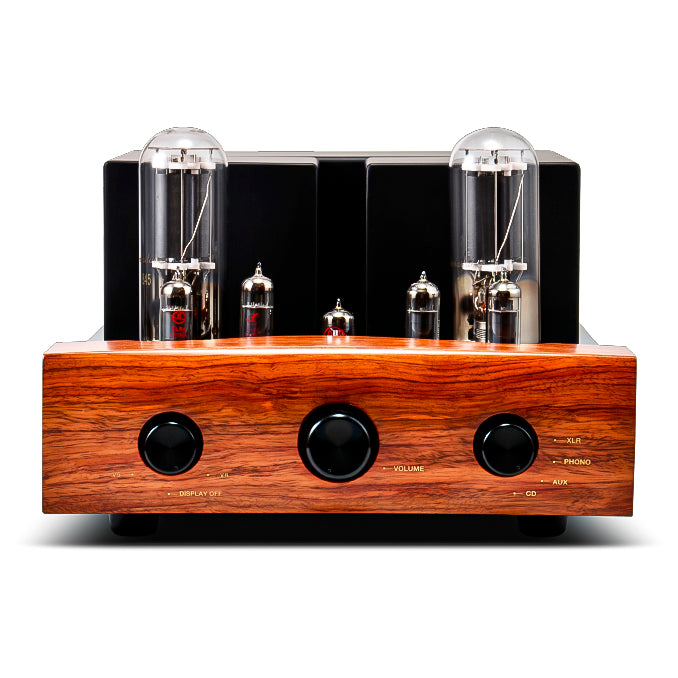

What is an attenuator?
Attenuator (ATT) is a resistance attenuator. It is a kind of volume control, and by turning the knob to the right or left, the level (strength) of the sound changes +/-. It may be continuously variable, or it may be a step type with a decibel scale.
Role in the speaker
Click here for the speaker product page
When used in speakers, the attenuator has the role of flattening the characteristics by filling in the level differences between the constituent units such as the woofer, squawker, and tweeter.

Speakers are usually designed with squawkers and tweeters to be more efficient than woofers, so an attenuator is installed to adjust the level of the squawker or tweeter. The level between the units can be adjusted to suit the conditions of the room where the audio is installed and the genre of music being listened to.
It seems that the types of speakers used these days are limited, so you don't see them very often. This is also the case with the manufacturers we handle, but they are unnecessary because the sound is tuned with high precision along with the network circuit inside the speaker.
Amplifier volume adjustment function
You can choose attenuatorBakoon ProductsClick here for the preamplifier PRE-7610MK4
You can choose attenuatorBakoon ProductsClick here for the power amplifier SCA-7511MK4
Another way attenuators are used is in amplifiers as volume circuits, and passive attenuators that remove the amplification circuit from amplifiers, which are incorporated into devices that are particularly focused on sound quality and volume control functions.
Amplifiers generally have a volume adjustment function, so you might think that the only thing you can do is change the volume, but an attenuator is a wonderful thing that can dramatically change the sound just by changing this part.
Equipped with attenuatorASTORClick here for preamplifier AS-XP88EZC
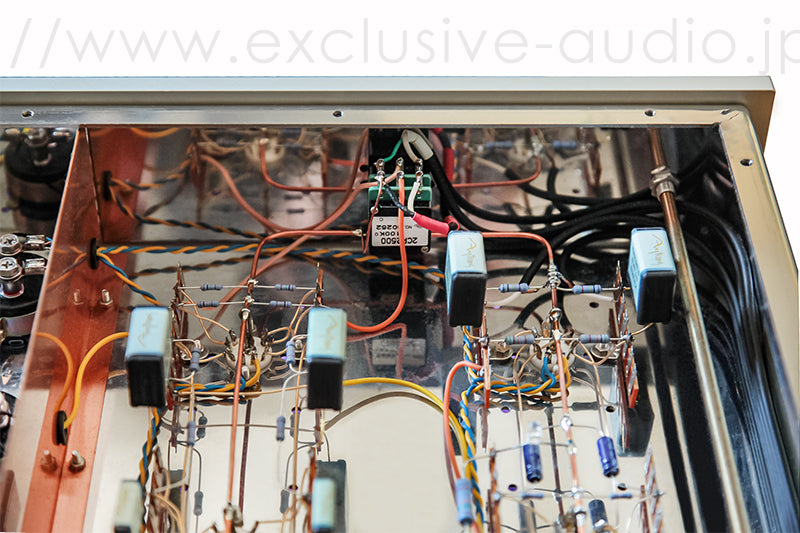
By adopting an attenuator in the volume section of an amplifier, it becomes possible to reproduce sound with higher detail and accuracy than that achieved by a standard volume circuit, providing expansive and expressive music. Additionally, the precision of the resistors also affects the accuracy of the reproduced sound.Bakoon ProductsIn amplifier series such as this, in addition to the standard volume, as an option, you can choose metal film resistors which have low current noise, high accuracy, and excellent characteristics, or non-inductive wound resistors which greatly reduce parasitic inductance, which can cause signal waveform distortion (linking) in circuits with magnetic flux inside the amplifier. As the accuracy of the resistors increases, the price also rises, so it is advisable to choose according to your preferred music genre.

Passive Attenuator
Yamamoto Sound CraftThe passive attenuator AT-03-1A is here
Yamamoto Sound CraftThe passive attenuator AT-03-3A is here
A "passive attenuator" is a device with a simple volume adjustment mechanism composed only of passive components, without using amplification elements such as vacuum tubes or transistors or buffer circuits that transmit audio signals to speakers or power amplifiers installed in an amplifier. It requires no power, and since it has no amplification circuits, the low frequencies tend to be light. However, even taking this into account, a minimally configured passive attenuator has ample sound freshness and resolution, as well as lively high frequencies, rich information, and clarity, offering an appeal that is difficult to achieve with a preamplifier.

It can express the spikeless and clear high tones of wind instruments, the subtle touch variations of piano playing, and the details of each note of violin or classical guitar strings. The light tone and moderate low frequencies are comfortable to listen to. Passive attenuators, being natural, delicate, high in sound information, and fresh, are especially recommended for listeners who mainly enjoy classical music in small ensembles or solo performances.