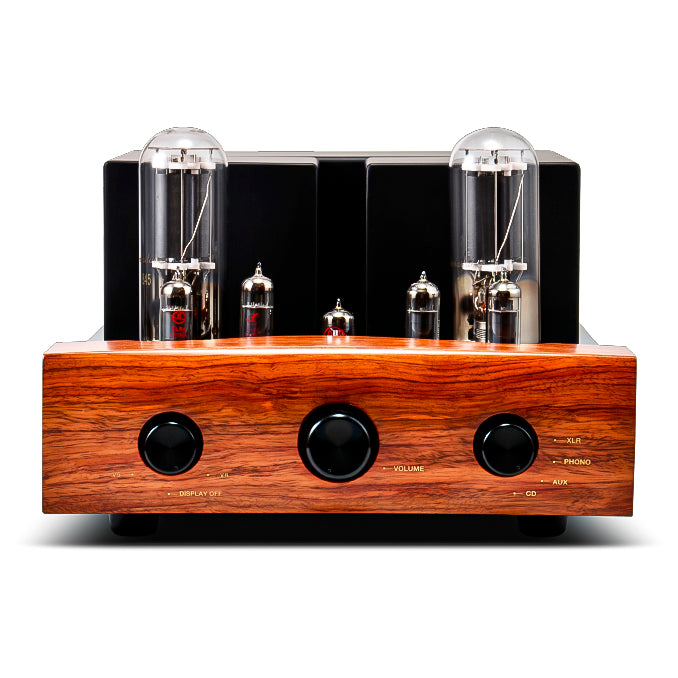

OTL amplifiers (Output Transformer Less amplifiers) are exactly what they callWithout the use of output transformersIt is an amplifier with a design concept that tries to deliver signals from the output stage of a vacuum tube to the speaker. A typical tube power amplifier uses an output transformer to match the high output impedance of the tube to the speaker. OTL, on the other hand, avoids the constraints and coloring caused by the transformer by omitting the "converter", and establishes speaker drive in a different way. This is where the charm and difficulty of OTL coexist.
1. What output transformers give to "sound" and the purpose of OTL
The output transformer is the cornerstone of a tube amplifier. It is responsible not only for impedance matching, but also for many other tasks, such as electrical isolation, DC interruption, and the establishment of gain structures. But at the same time, since the transformer is a physical device, it is far from ideal. For example, it is difficult to avoid magnetization and saturation of the iron core at low frequencies, leakage inductance and parasitic capacitance of windings at high frequencies, phase rotation at the band end, and characteristics that change under load conditions. The better the transformer, the higher the bandwidth, low distortion, and lower loss, but the size, weight, and cost also increase, and the aspect of being pulled by the impedance fluctuations of the speaker remains.
OTL cuts in here. **The idea is that "no transmission = no limits of transance". As a result, it is said that it is easy to develop its unique charm, especially in the transparency of the mid and high frequencies, the speed of start-up, the nuances of the microsignal, and the good absence of sound images. Of course, it is not that "trance is bad", but it is appropriate to understand that OTL is a method that tries to approach the ideal with a different solution.
2. Circuit approach to OTL
The biggest hurdle isHigh output impedance of vacuum tubesThat's what it is. Without a transformer, you can't brake a speaker around 8Ω as it is. Therefore, OTL mainly uses the following means:
(1) Reducing impedance with many parallels (parallel)
Typically, multiple low-internal resistance double triodes, such as the 6AS7/6080, are paralleled to reduce output impedance and increase current supply capacity. As a resultThe number of vacuum tubes tends to be largeSo, the heat generation increases, but it is the royal road that makes it easy to get OTL-like driving power.
(2) Cathode Follower Output, SRPP, White Cathode Follower, etc.
For the output stage, circuits that are likely to achieve low output impedance are typically chosen. All of these are designed to facilitate current delivery, but the characteristics of the circuit, stability, and the compatibility with the tubes used directly affect the sound.
(3) Presence or Absence of Output Capacitors (Direct Coupling vs. Capacitor Coupling)
OTL stands for "Output Transformer-Less," butwhether or not to include a capacitor at the outputis a separate issue. Using a large capacitor in series with the speaker to block DC is an implementation that is easy to understand, but the quality and value of the capacitor can affect the texture of the low frequencies. On the other hand,direct couplingdesigns that insist on connecting directly reduce the involvement of components, though managing DC offset and protection circuits becomes more difficult. In OTL, whether to choose one method or the other defines its character.
[Input] → [Voltage Amplification Stage] → [Driver Stage] → [OTL Output Stage] → [DC Measures/Protection] → [Speaker]
+B
|
+-----+-----+
| |
Upper Output Group Lower Output Group
(Current Supply / Pull-up) (Current Sinking / Pull-down)
| |
+-----+-----+----o Output Node
|
+---||---o----[SP]----o GND
Cout
In OTL, it is essential to design so that DC does not flow to the speakers. A representative method is placing a large capacitor (Cout) in series at the output to block DC. The capacitance and quality of the capacitor also affect the texture of the low frequencies.
3. How to Understand the Sound Characteristics of OTL
When discussing OTL, the commonly mentioned impressions are as follows:
-
Transparency and Speed in the Mid-to-High Range:- This often results from the straightforward phase response and ease of small signal transmission due to bypassing a transformer.
-
Clarity of Soundstage:- Often, separation is good and the sense of depth can feel three-dimensional.
-
Low-Frequency Texture Varies Greatly with Design and Load:- It does not necessarily mean that the bass is weak; however, the sense of control and weight can vary depending on the relationship between the speaker's impedance characteristics and the amplifier's output impedance.
The key point is that OTL’s low frequencies are not about "whether they are present or not," but rather"How it comes out" is easy to change depending on the loadThat's what it is. If the speaker has a low minimum impedance (well below 4 ohms, phase runaway), OTL tends to be at a disadvantage in terms of current delivery and stability. On the other hand, the impedance is relatively gentle, and the advantages of OTL are very easy to come out at high efficiency or at loads such as 16 Ω nominal.
4. Practical precautions ("difficulty" of OTL)
As an audio enthusiast, I want to keep in mind that OTL is not only romantic, but also requires unique consideration in terms of operation.
-
Heat and power consumption: Numerousoutput tubeThere are many designs that line up the
-
Ball matching and deterioration: The more parallel the number, the easier it is to produce a difference in characteristics. High value of regular inspections
-
Protection and safety: In the case of direct connection types, DC accident countermeasures (protection relays, etc.) are important. Good design is directly related to reliability
-
Speaker Aptitude: Compatibility varies greatly depending on minimum impedance, phase rotation, and network complexity
5. What kind of people will be stuck in OTL
OTL is a method that is easy to stick to those who value not only the density and smoothness of the sound, but also the "directness" and good visibility. The sound of strings rubbing, the breathing of vocals, the rise of piano keystrokes, and the disappearance of hall tones naturally depict information on the time axis, and many of them have subtle nuances that come to light.
On the other hand, speakers with low minimum impedance and large load fluctuations due to frequencyStrong control with high current supply and high braking forceIf you want to prioritize, it is reasonable to choose OTL with a wide range of design or to compare it with a different method: a vacuum tube with a powerful output transformer or a semiconductor with high damping.
The option of Q-tron's OTL (Futterman circuit)
An essential part of talking about the history of OTL amplifiers is the OTL circuit philosophy proposed by Julius Futterman. The Futterman circuit is known as a practical approach to achieving speaker drive without relying on output transformers, and it also shows that OTL is not just an "outlier", but a full-fledged technical system.
Q-tron Audio's amplifier isOTL based on the lineage of Futterman circuitsIt is positioned as. In other words, the aim is clear, and it is to draw out the "direct transmission" obtained by not going through the output transformer through circuit design to establish OTL. While OTL is attractive as a method, there are many issues that need to be solved in order to be established as a product, such as heat generation, ball management, resistance to load fluctuations, and DC and protection design. That's why the amplifier that advocates Futterman-type OTL isThe core idea is to increase current supply capacity by push-pulling the output stages arranged above and below to reduce the effective output impedance. While aiming for the "directness" of OTL, stability and perfection in the protection design determine sound and reliability.
+B
|
[Upper Output Stage] ← Lifting Side
|
o---- Output Node ----|| ----o----[SP]----o GND
| Cout
[Lower Output Stage] ← Down Side
|
-B / Suspected GND
The core of the Futterman series is the idea of moving the output stages placed up and down in a push-pull manner to earn current supply capacity, which is often lacking in OTL. While aiming for the "directness" of OTL, stability and perfection of the protection design are important.

For example, the following values are what stick to Q-tron's OTL.
-
Rather than coloring and band-end habits derived from output transformers,Good view, gap, gradation of spaceI want to focus on
-
It's not just about the volume of the low frequencies,Rise and fall, the core of the rhythmI want to give priority to
-
I want to enjoy the charm of tube amplifiers not only as "smoothness", but also as the amount of information (nuances, vanishings, signs) of the time axis**
If you're interested in OTL, Q-tron's Futterman circuit OTL can be your gateway to the mainstream. Not only the single point of removing the transformer, but also the accumulation of ideas and designs to establish it as OTL supports the persuasiveness of the sound. When the speaker conditions are met, the "directness" of OTL should stand up as a solid experience, not just an impression.
Click here for the Q-tron OTL amplifier product page
https://exclusive-audio.jp/collections/qtron
Information on rental of listening devices (only in Japan)
Would you like to experience the charm of Q-tron Audio's OTL amplifier in your own audio environment?
Our store offers a listening device rental service for customers considering purchasing.
The loan period is one week, and you will only be responsible for shipping costs.
If you would like to borrow it for a preview, please contact us here.